Showing posts with label Painted Hills. Show all posts

Tuesday, January 13, 2015

Top 10 All-Time Posts (sorry 2014, no slight intended!).

I know what you are thinking (besides how late this post is), shouldn't this be about my top posts for 2014?  Well, that seems to be everyone's offering this time of year, so why not "shake it up", "go against the grain", "stand up to the man", "think outside the box", "go down the path less traveled", "be my own individual" - whatever you want to call it.  Let's do this!

1.  The North Circle - Glacier National Park.


The Garden wall above flower meadows in Granite Park, Glacier National Park, Montana, USA.
Flower meadows below Fifty Mountain.
My all-time highest viewed post by far is about a backpacking trip I did several years ago in Glacier National Park.  The North Circle provides some of the most beautiful backcountry scenery the park has to offer.  The trip begins at Logan Pass and ends at Many Glacier (or vice versa).

We spent a total of 7 days doing the North Circle in August, spending time at Granite Park, Fifty Mountain, Sue Lake, Stoney Indian Pass & Lake, Mokowanis Lake, Elizabeth Lake & Ptarmigan Tunnel. Sue Lake was accessed by climbing over the shoulder of Mt. Kipp from Fifty Mountain and descending the Chaney Glacier down to Sue Lake Bench. A cross country descent led us down to intersect the Stoney Indian Trail and put us back on the North Circle proper. This variation allowed us to avoid descending several thousand feet down to Waterton Lake, only to have to regain it again to Stoney Indian Lake. And Sue Lake Bench was worth its hardships in gold.

This was a very special trip filled with excitement and adventure, and plenty of wildlife (including a grizzly encounter).  I'm ready to go back!

2.  Photographing Yellowstone National Park.


Blue skies reflected in the waters of Crested Pool, Yellowstone National Park, Wyoming, USA.
Crested Pool.
I've spent a lot of time in Yellowstone National Park.  It's an amazing place for photography.  There is so much variety available that something is bound to capture the interest of most shutterbugs.

The park has very distinct features, offering geysers, hot springs, waterfalls, terraces and mud pots.  Each of these features require a slightly different approach with the camera, as well as lighting and weather conditions. 

There is enough to keep you busy here for weeks!  What's more, the abundant wildlife will adds a definite bonus!

3.  Photographing the Enchantment Lakes


Prusik Peak above fall larches at sunrise as a storm clears, Enchantment Lakes, Alpine Lakes Wilderness, Washington, USA.
Prusik Peak at sunrise.
The Enchantment Lakes are one of the most beautiful destinations our state of Washington has to offer.  The high alpine lakes are set in granite basins surrounded by larches that turn brilliant gold in fall, and towering peaks above. They attract photographers, hikers and climbers from around the country.

You must have a permit to visit this fantastic place, which encourages one to plan in advance.  Of course, if you're feeling lucky, you can roll the dice the morning of by playing their lottery system.  Don't get caught without a permit; the rangers patrol the area and strictly enforce the permit policy.

The Enchantment Lakes are best visited from late July through mid-October.  Late July-early August will often find the area mostly snow-covered, though peaks are very accessible.  Late August and September are the best hiking months; the area is mostly melted out and the weather generally continues to be nice.  This is a great time to explore and scramble in the upper basin.  October offers the turning of the larches, as well as the seasons.  It's common  to have a dusting of snow on the ground, making off-trail travel in the upper basin tricky.  Though photographic throughout the summer, October offers a photographer's paradise when the larches can be timed right.  Unfortunately, the weather can be unpredictable and present challenges.  One must be prepared for winter conditions, or to even cancel their trip altogether.

4.  Buck Creek Pass/Spider Gap Loop


Early light on Glacier Peak above Image Lake in the Glacier Peak Wilderness, North Cascades, Washington, USA.
Glacier Peak above Image Lake.
The Buck Creek Pass - Spider Gap loop is considered one of the premier backpacking trips in Washington, and with good reason.  Glaciers, high passes and lakes abound along this fantastic trek.  Throw in a side trip to Image Lake (a must!) and this classic is raised to an even higher bar.  Do this trip during flower season and it will add to your enjoyment and photography.  This is an outstanding flower hike in season!

I found my 24-70mm lens to be my only lens used on this trip.  I carried my 17-40mm, but it never saw the light of day.  I left the bigger glass at home, as I typically due on such extended trips.  The weight isn't worth it.

I highly recommend this extended backpack!  I would budget 6-7 days to really enjoy all it has to offer.  I would not consider anything less than 4-5 days.

5.  Dr. Jose Rizal Park - Wow!


Seattle at night from Dr. Jose Rizal Park, Seattle, Washington, USA.
Seattle from Dr. Jose Rizal Park.
Dr. Jose Rizal Park has amazing views of the Seattle skyline from the south, as well as Safeco and Qwest Field, and Elliot Bay.

The first view that gets your attention is obviously the view of the city and the freeway wrapping around it. At night (or early morning in my case), headlights and taillights create colorful streams of ribon during long exposures. The above image was exposed at 15 seconds, f16.
Qwest Field (now Century Link) is a close second in the running for your attention from this park, at least at night. The colorful blue roof serves as a beacon south of the city.

Dr. Jose Rizal Park is located on Beacon Hill, just off of Dearbon Street (the exit to take off I-5). The approach from the south is a little indirect due to one-way streets and freeway obstruction, but it is worth the effort! Check it out next time you are in the area!

6.  Painted Hills Unit - John Day Fossil Beds NM


Painted Hills at sunset in the John Day Fossil National Monument, Oregon, USA.
Painted Hills at sunset.
 The Painted Hills Unit of John Day Fossil Beds National Monument is one of the most popular subjects in Oregon for landscape photographers. It is also the most well known of the unique formations within the monument.

Located near Mitchell, Oregon, the Painted Hills are a photographer's dream. They are colorful, patterned, contrasting, unique and extremely fascinating. Their colors change throughout the day and with even the most subtle change in light. They consist of stratifications of yellow, gold, black, and red as a result of layers of fallen volcanic ash from ancient volcanoes.  The Painted Hills are truly a photographer's delight!

7.  Artist's Palette - Death Valley National Park.

Artist's Palette in Death Valley National Park, California, USA.
Artist's Palette in Death Valley National Park.
Artist's Palette is on the face of the Black Mountains along Artist's Drive in Death Valley National Park.

As the name would suggest, it broadcasts an aray of attractive colors in its rock. The colors are brought on by the oxidation of different metals; red, pink and yellow is from iron salts, green is from decomposing mica, and the purple is from manganese.

The Artist's Drive area provides evidence of one of Death Valley's most violently explosive periods, though this is not the predominant thought on your mind while viewing these colors of the rainbow.

8.  In memory of Karen Sykes, 1945 - 2014

This is the saddest entry on the list.  The hiking community lost a truly special person and lover of life itself this year.


Image of Karen Sykes, courtesy Alan Bauer.
Karen Sykes, 1945 - 2014 (image courtesy Alan Bauer)
I first met Karen in 2007 - March 13th, 2007 to be exact.  It was a special day because it marked my first time hiking with her and another new friend, Alan Bauer.  Little did I know that both would become very good friends and colleagues.
On June 18th, Karen met her fate doing what she loved.  Her final adventure took place in Mount Rainier National Park, on a hike to Owyhigh Lakes with her boyfriend Bob.  Karen did not return. 

There are more questions than answers as to what happened on that day.  And most likely, many of those answers will never come.

I will miss Karen.  I will miss her joyous smile and infectious laugh.  I will miss her quest for adventure and seeking to notice details along the way that others might overlook.  I will miss her kind heart and goodwill to those around her whom she found so important in her life.

Rest in peace, Karen.  You have touched the lives of more than you ever could have imagined, and will be sorely missed.

9.  New Years Eve From Kerry Park!


The city of Seattle from Kerry Park on Queen Anne Hill, Seattle, Washington, USA.
Seattle cityscape from Kerry Park.
Kerry Park is one of, if not the, supreme view of the city skyline that Seattle has to offer, and includes the bonus of Mount Rainier off on the horizon. The visual is magical.

Access to the park was pretty straight forward and easy, even on such a day as New Year's Eve. It is certainly a popular spot, but as with many tourist locations, people come and people go. Too crowded for you? Wait 10-15 minutes.

Kerry Park is not very large. In fact, the "park" is mostly down below viewpoint, and requires a steep descent to visit. Kerry Park as photographers know it is more of a paved viewpoint, roughly 100 feet long. The best vantage if from the far west (right) end near the steps that descend to the play area and basketball court.

A visit to Kerry Park at sunset should be a must on every visitor's list. I strongly recommend it.
The park is located on Queen Anne hill, just west of Queen Anne Ave.

10.  Updated! New for the Holidays - Poster Prints!

Mount Rainier above flower meadows on Mazama Ridge near Paradise, Mount Rainier National Park, Washington, USA.I'm excited to share my newest product with you - poster prints! These 12x18 standard sized prints were created by my good friends at ADG Printing in Lynnwood just in time for the holidays and my upcoming shows! They represent 6 of my most popular images from my home state of Washington, and some personal favorites as well.


Well, that's it!  Now it's time to shed the past and move ahead to 2015.  I hope all your hopes and plans see fruition, and that it is a great year for everyone!

See you on the trail!


Friday, April 4, 2014

Spring Photography Ideas Around the Pacific Northwest

The Washington State Capital Building (Legislative Building) and a carpet of daffodils, Olympia, Washington.
 Spring has arrived in the Pacific Northwest, which means it's time to get the camera out for some fresh air!  There are lots of places begging to be visited in the spring months, so I thought I would list some of my favorites.

The State Capital Building (or Legislative Building) is a beautiful place to visit in the spring time, especially if you can catch the cherry blossoms and daffodils in mid to late March, or the tulips in April.  Early morning will provide relative peace and quiet before the masses arrive later in the day.

The University of Washington campus is also an excellent place to catch the cherry blossoms in late March or early April.

The Washington Park Arboretum and Japanese Garden are beautiful in the spring time, particularly from mid-March to early May.  You will want to head to Rhododendron Glen and walk Azalea Way.  Unfortunately for photographers, the Japanese Garden has restricted hours, charges admission, and tripods are not allowed (though monopods are).  Still, I understand it to be a must visit!


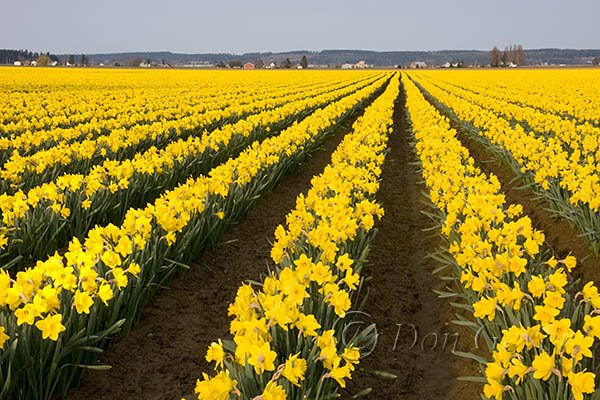
A yellow field of daffodils in the Skagit Valley, Mount Vernon, Washington.
 The Skagit Valley is popular in the spring for a reason - fields upon fields of flowers!  The blooms start in late March with the daffodils.  Because they are not nearly as popular as the tulips, this is a relatively quiet time to visit, and the rewards are great.  You might be surprised at how many different varieties of daffodils there actually are.  Definitely dress for wet weather and muddy fields this time of year.  Rubber boots are recommended.  Be sure to check out the bloom map when planning your visit.

Tulips in bloom in the Skagit Valley, Mount Vernon, Washington.
 In early to mid-April, things get crazy around Mount Vernon with the arrival of the tulips, and visitors from around the world.  Weekends in particular can be a mad house.  But if you arrive early in the morning, you can still get a few hours of rewarding photography before the masses arrive.  I recommend arriving before sunrise and photographing the fields.  Again, refer to the bloom map.  By mid-morning, you will want to visit RoozenGaarde and/or Tulip Town before the lines get too long.
 
Tulips in bloom in the Skagit Valley, Mount Vernon, Washington.
 Sunset is also a fantastic time to photograph the fields.  Admittedly, I've never lasted this long!  By late morning or noon, I am always spent and ready to call it a day.  But one of these days I am going to forgo the early morning and plan a late visit just for this purpose.

Palouse Falls is now our official state waterfall.  Have you been there?  Why not?  It's a beautiful state park on the eastern side of Washington - southeastern, to be exact.

A rainbow forms at the base of Palouse Falls, Palouse Falls State Park, Washington.
April and early May are excellent times to visit this majestic waterfall.  The weather is typically nice more times than not, and the heat of summer has not hit yet.  The cooler days of April are still a bit chilly for rattlesnakes liking, but the warmer days of May can be a different story.

Palouse Falls State Park is a 105 acre park that offers a nice picnic area, overnight tent camping on a first come, first served basis, and of course, the dramatic view of the waterfall itself.  It's a bit off the main road (dirt road access), and not recommended for trailers or RV's.  The park itself is stunning.

On sunny days in the spring, a rainbow forms at the base of the falls in late afternoon.

If you are into waterfalls - and I mean lots of them, there is no better destination than the Columbia River Gorge National Scenic Area to the south of us.  Just a short distance east of Portland (16 miles) the waterfalls begin.  Be sure and drive the Columbia River Gorge Highway, both for the history and the views!  This highway stretches from Troutdale to Dobson, OR and provides direct access to most of the waterfalls.

Multnomah Falls in the Columbia River Gorge National Scenic Area, Oregon.
The most popular waterfall in the gorge is Multnomah Falls, because of its picturesque postcard appearance (and it has appeared on many a postcard!).  Unfortunately, the Benson Bridge which famously spans this graceful waterfall was heavily damaged this past winter, and is currently closed for repair work.  This simply means you can't hike the trail to the top.  You can still enjoy the famous view from the bottom!

Also nearby are Latourell Falls, Horsetail Falls, Ponytail Falls, Elowah Falls, McCloud Falls, Triple Falls, Wahclella Falls, Wahkeena Falls, Punch Bowl Falls, Bridal Veil Falls...well, you get the picture!

There are waterfalls for every interest and ability.  Some can be viewed from the parking lot, some require a short walk to a viewing point, and others require a short hike up a trail through beautiful forest.

To get the most out of your visit photography wise, I would plan your visit for a cloudy, overcast day.  This allows for even lightning and one doesn't have to hassle with the contrasting shadows and brightness of sunny days.

The Stonehenge Memorial on May Hill in Washington State.
While you're down there, don't forget to jump over to the Washington side of the gorge and visit Beacon Rock State Park and the Stonehenge Memorial in Mayhill, honoring our war veterans.  It's a full size, astronomically-aligned replica of the original Stonehenge, completed in 1929.

Stonehenge is best photographed under blue skies, hopefully with a cloud or two present to make the sky more interesting.

Smith Rock State Park in Bend, OR might be a little further than some people want to drive, but I can promise you won't be disappointed.

This beautiful park might be most famous amongst rock climbers for its challenging routes on excellent quality rock.  But it really offers something for everyone with its network of hiking trails and supreme views of its giant monoliths.  Keep an eye out for rattlesnakes as they are very common here.  There is no camping here, other than the "parking lot" offered to rock climbers.

A panoramic view of the Painted Hills in John Day Fossil Beds National Monument, Oregon.
 Finally, east of Bend, there is the John Day Fossil Beds National Monument.  More specifically, the Painted Hills Unit located about 9 miles northwest of Mitchell, OR.  This unit covers 3,132 acres and offers a short boardwalk trail, the main viewpoint trail (where these pictures were taken) and a longer trail to a grand viewpoint overlooking the entire area.

Camping is primitive in this area, though one has the option of camping in the city park in downtown Mitchell, believe it or not!

A panoramic view of the Painted Hills in John Day Fossil Beds National Monument, Oregon.
 As for photographing the painted hills, the best time is in the evening shortly before sunset.  This is when the colors are at their best.  And if you are lucky enough to have some nice, dark storm clouds off in the distance to the east - even better!

Why spring for this year around attraction?  Because flowers put on a display in early May.

Well, there they are - some of my favorite spring photography destinations in the Pacific Northwest.  I hope you will have the opportunity to visit some, if not all these places in the coming years.

As always, feel free to contact me with specific questions.

If you wish to view more pictures, visit my galleries at www.mountainscenes.com.

Thanks for looking!


Monday, October 25, 2010

Painted Hills Unit - John Day Fossil Beds National Park

One of Oregon's most recognizable locations, the Painted Hills are a photographer's delight, offering an array of contrasting colors, appearing to have been "painted" on the hillsides. The colors change with the light throughout the day - from gold and orange to deep reds at twilight. Add some storm clouds in the sky and the scene becomes even more intense!

The Painted Hills Unit are located 9 miles from Mitchell, and 75 miles east of Bend. Flowers here typically peak in late April or early May. I missed them on this particular trip (giving me reason to go back!).

I've recently added a new gallery of these images to my web site, to include the Sheep Rock Unit, as well as a new Smith Rock State Park gallery. It was fun to revisit this trip and relive the memories. I hope you enjoy.

Tuesday, May 26, 2009

Painted Hills Unit - John Day Fossil Beds National Monument

The Painted Hills Unit of John Day Fossil Beds National Monument is one of the most popular subjects in Oregon for landscape photographers. It is also the most well known of the unique formations within the monument.

Located near Mitchell, Oregon, the Painted Hills are a photographer's dream. They are colorful, patterned, contrasting, unique and extremely fascinating. Their colors change throughout the day and with even the most subtle change in light. They consist of stratifications of yellow, gold, black, and red as a result of layers of fallen volcanic ash from ancient volcanoes.

I had planned my trip for early May in hopes of hitting the flowers at their prime. But it has been a strange year with flowers running about two weeks late in many areas, and I missed out on the show. Next time!

I did not miss out on some special light and memories however. My first evening photographing the Painted Hills was under a cloudless sky. I was mostly alone. I focused on isolating various patterns and shapes in my compositions. It was a lot of fun!

My second night was not by design. I was actually photographing in the Sheep Rock Unit when clouds and scattered showers moved in. When late light looked doubtful, I jumped in my truck and raced back to the Painted Hills Unit in hopes of having dark storm clouds above my subject as rays of light breached thru. Well, the clouds had come and gone by the time of my arrival - it was a quick storm. But some clouds did linger and made the evening light very interesting. There were more photographers present, and all were fun to talk with.

I made friends with two photographers in particular; Jeff Chen and Long Nguyen. Jeff is a very successful medium format panoramic landscape photographer from San Francisco. Long is a local photographer from Seattle with big asperations and much talent. I hope to connect with both of them again in the future.

The small town of Mitchell is very close to the Painted Hills and offers gas, food and lodging. The locals were as friendly as could be to me and I made a point to gas up and do my shopping there rather than making the longer trip to Prineville. It feels good to know you are helping the local economy, as well as saying Thank You for their generous hospitality and helpful recommendations on the area.

Camping is available in the city park - which offers nice picnic tables and barbeques. Just pitch your tent next to the table you wish and you are good to go!

There are also several National Forest Service campgrounds in the area, though they are a bit longer drive and as such, not as convenient.

I found the best camping to be along the road to the entrance of the Painted Hills Unit. They offer nothing more than a fire pit (no immenities), but are convenient and relatively private. By the way, there is no camping allowed within the Painted Hills Unit - despite what some locals might tell you.

This is my last entry on my visit to John Day Fossil Beds National Monument, though not from my trip (yes, there is more to come!). The John Day area is certainly a destination, not just a stop-over. Plan to spend 2-3 days there to get the most from your visit!

In closing I would like to give another shout to Greg Vaughn and his book Photographing Oregon. The book really helped me with my photography planning, and he personally volunteered additional information in hopes of making my trip even more successful.