Showing posts with label Skagit Valley. Show all posts

Sunday, January 26, 2025

Almost Daffodil Season!

That's right.  It's almost daffodil season here in the Pacific Northwest!  The season typically begins in early March in the Skagit Valley, painting the fields in a wide variety of colors, but predominantly yellow.  They are the precursor to the tulips, which will begin to arrive in early April.

But back to the daffodils.  They don't receive nearly the crowds that the tulips generate.  I think there are several reasons behind this.  The tulips are the more famous flower and have a festival built around them.  They are the highlight of the Roozengaarde gardens, with so many different varieties and colors.  The daffodils appear in them too, as seen in this photo.  However, they mostly seem to play a complimentary roll.

March can also be a challenging time to visit due to weather.  The fields can be wet and muddy, and snow is still a real possibility.  The temperatures can be cold.  Still, there are often nice weather windows to jump at the opportunity for a visit.  To visit the fields is free and Roozengaarde offers a map on their website which shows the locations (the fields vary year-to-year, as they don't plant consecutive years), and the current bloom situation.

The image above is from their garden, which requires an admission fee (well worth it).  I'm proud to share that it currently appears on a UK 2025 wall calendar.

You may view this and many other daffodil images in my Daffodils - Skagit Vallery Gallery.

As always, thanks for looking!  Maybe I'll see you there!

Friday, April 4, 2014

Spring Photography Ideas Around the Pacific Northwest

The Washington State Capital Building (Legislative Building) and a carpet of daffodils, Olympia, Washington.
 Spring has arrived in the Pacific Northwest, which means it's time to get the camera out for some fresh air!  There are lots of places begging to be visited in the spring months, so I thought I would list some of my favorites.

The State Capital Building (or Legislative Building) is a beautiful place to visit in the spring time, especially if you can catch the cherry blossoms and daffodils in mid to late March, or the tulips in April.  Early morning will provide relative peace and quiet before the masses arrive later in the day.

The University of Washington campus is also an excellent place to catch the cherry blossoms in late March or early April.

The Washington Park Arboretum and Japanese Garden are beautiful in the spring time, particularly from mid-March to early May.  You will want to head to Rhododendron Glen and walk Azalea Way.  Unfortunately for photographers, the Japanese Garden has restricted hours, charges admission, and tripods are not allowed (though monopods are).  Still, I understand it to be a must visit!


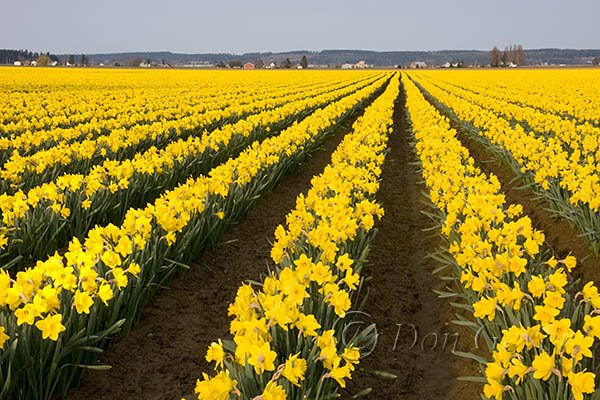
A yellow field of daffodils in the Skagit Valley, Mount Vernon, Washington.
 The Skagit Valley is popular in the spring for a reason - fields upon fields of flowers!  The blooms start in late March with the daffodils.  Because they are not nearly as popular as the tulips, this is a relatively quiet time to visit, and the rewards are great.  You might be surprised at how many different varieties of daffodils there actually are.  Definitely dress for wet weather and muddy fields this time of year.  Rubber boots are recommended.  Be sure to check out the bloom map when planning your visit.

Tulips in bloom in the Skagit Valley, Mount Vernon, Washington.
 In early to mid-April, things get crazy around Mount Vernon with the arrival of the tulips, and visitors from around the world.  Weekends in particular can be a mad house.  But if you arrive early in the morning, you can still get a few hours of rewarding photography before the masses arrive.  I recommend arriving before sunrise and photographing the fields.  Again, refer to the bloom map.  By mid-morning, you will want to visit RoozenGaarde and/or Tulip Town before the lines get too long.
 
Tulips in bloom in the Skagit Valley, Mount Vernon, Washington.
 Sunset is also a fantastic time to photograph the fields.  Admittedly, I've never lasted this long!  By late morning or noon, I am always spent and ready to call it a day.  But one of these days I am going to forgo the early morning and plan a late visit just for this purpose.

Palouse Falls is now our official state waterfall.  Have you been there?  Why not?  It's a beautiful state park on the eastern side of Washington - southeastern, to be exact.

A rainbow forms at the base of Palouse Falls, Palouse Falls State Park, Washington.
April and early May are excellent times to visit this majestic waterfall.  The weather is typically nice more times than not, and the heat of summer has not hit yet.  The cooler days of April are still a bit chilly for rattlesnakes liking, but the warmer days of May can be a different story.

Palouse Falls State Park is a 105 acre park that offers a nice picnic area, overnight tent camping on a first come, first served basis, and of course, the dramatic view of the waterfall itself.  It's a bit off the main road (dirt road access), and not recommended for trailers or RV's.  The park itself is stunning.

On sunny days in the spring, a rainbow forms at the base of the falls in late afternoon.

If you are into waterfalls - and I mean lots of them, there is no better destination than the Columbia River Gorge National Scenic Area to the south of us.  Just a short distance east of Portland (16 miles) the waterfalls begin.  Be sure and drive the Columbia River Gorge Highway, both for the history and the views!  This highway stretches from Troutdale to Dobson, OR and provides direct access to most of the waterfalls.

Multnomah Falls in the Columbia River Gorge National Scenic Area, Oregon.
The most popular waterfall in the gorge is Multnomah Falls, because of its picturesque postcard appearance (and it has appeared on many a postcard!).  Unfortunately, the Benson Bridge which famously spans this graceful waterfall was heavily damaged this past winter, and is currently closed for repair work.  This simply means you can't hike the trail to the top.  You can still enjoy the famous view from the bottom!

Also nearby are Latourell Falls, Horsetail Falls, Ponytail Falls, Elowah Falls, McCloud Falls, Triple Falls, Wahclella Falls, Wahkeena Falls, Punch Bowl Falls, Bridal Veil Falls...well, you get the picture!

There are waterfalls for every interest and ability.  Some can be viewed from the parking lot, some require a short walk to a viewing point, and others require a short hike up a trail through beautiful forest.

To get the most out of your visit photography wise, I would plan your visit for a cloudy, overcast day.  This allows for even lightning and one doesn't have to hassle with the contrasting shadows and brightness of sunny days.

The Stonehenge Memorial on May Hill in Washington State.
While you're down there, don't forget to jump over to the Washington side of the gorge and visit Beacon Rock State Park and the Stonehenge Memorial in Mayhill, honoring our war veterans.  It's a full size, astronomically-aligned replica of the original Stonehenge, completed in 1929.

Stonehenge is best photographed under blue skies, hopefully with a cloud or two present to make the sky more interesting.

Smith Rock State Park in Bend, OR might be a little further than some people want to drive, but I can promise you won't be disappointed.

This beautiful park might be most famous amongst rock climbers for its challenging routes on excellent quality rock.  But it really offers something for everyone with its network of hiking trails and supreme views of its giant monoliths.  Keep an eye out for rattlesnakes as they are very common here.  There is no camping here, other than the "parking lot" offered to rock climbers.

A panoramic view of the Painted Hills in John Day Fossil Beds National Monument, Oregon.
 Finally, east of Bend, there is the John Day Fossil Beds National Monument.  More specifically, the Painted Hills Unit located about 9 miles northwest of Mitchell, OR.  This unit covers 3,132 acres and offers a short boardwalk trail, the main viewpoint trail (where these pictures were taken) and a longer trail to a grand viewpoint overlooking the entire area.

Camping is primitive in this area, though one has the option of camping in the city park in downtown Mitchell, believe it or not!

A panoramic view of the Painted Hills in John Day Fossil Beds National Monument, Oregon.
 As for photographing the painted hills, the best time is in the evening shortly before sunset.  This is when the colors are at their best.  And if you are lucky enough to have some nice, dark storm clouds off in the distance to the east - even better!

Why spring for this year around attraction?  Because flowers put on a display in early May.

Well, there they are - some of my favorite spring photography destinations in the Pacific Northwest.  I hope you will have the opportunity to visit some, if not all these places in the coming years.

As always, feel free to contact me with specific questions.

If you wish to view more pictures, visit my galleries at www.mountainscenes.com.

Thanks for looking!


Tuesday, April 10, 2012

Daffodils in the Skagit Valley


Rows of daffodils in the Skagit Valley.
 Each spring hundreds of thousands of people descend upon the Skagit Valley to enjoy the millions of tulips in bloom.   The rows upon rows of magnificent flowers are breathtaking.  I encourage all to experience it.

The Skagit Valley Tulip Festival officially runs from April 1 - 30th.  The tulip show, in my experience, typically hits peak about the second week of April.  However, the bloom dates are heavily dependent on weather and can vary greatly from year to year.

Fortunately, we have a tool available to us to take the guessing game out planning our visit.  Roozengaarde, one of the premier tulip growers in North America, publishes a bloom map with daily updates!

And now, to share another secret with you.  Want to avoid the crowds?  Go now!  Daffodils are at peak bloom right now and the fields are amazing!  There is a good chance you will find yourself all alone as you explore them.  It will be a much different experience in a week or two when the tulips hit peak.

Enjoy, and feel free to share your experience!

Wednesday, March 25, 2009

Daffodils in the Skagit Valley

March is here and that can only mean one thing - daffodils! These beautiful flowers begin popping up in flower beds in neighborhoods all over the Pacific Northwest this time of year.

Want to see more? I'll let you in on a little secret. Think Skagit Valley. Think Mount Vernon!


I say secret because, unlike the Tulip Festival that takes place next month and draws visitors from around the world, the daffodils attract a much smaller crowd. In fact, calling it a "crowd" is overselling it!

You can arrive at 8:00 am on a Saturday morning and possibly be one of only a handful of cars in the Roozengaarde parking lot - it happened to me last year!


Meanwhile, the fields of flowers are there in all their glory and variety of colors. Variety? Oh yes. If you thought daffodils only came in yellow, think again!


Though the varieties may not be as numerous as with the tulips, there are still enough to create attractive alternating rows in the fields. Bring your camera!


How to get there. If you've attended the Tulip Festival, the driving directions are exactly the same.


From Seattle, take I-5 north to Mount Vernon. Take the Kincaid Street exit (#226), go west on Kincaid. At the first stoplight after the railroad tracks, take a right. Go straight through 2 stoplights and over the Division Street Bridge. Continue to the first stoplight after the bridge, taking a left at the light onto Wall Street. Wall Street makes a quick right turn and becomes McLean Road.

Continue down McLean Road about 3 miles. Make a left at the grocery store onto Beaver Marsh Road, and begin watching for yellow fields on your right.


The main parking lot for Roozengaarde is 1/4 down on your right. There is another parking lot about 1/2 a mile further. Both offer access to excellent viewing opportunities.


How to view. I recommend viewing the fields first, especially if arriving early. If photography is your goal, I really recommend viewing the fields first. Both parking lots offer access to ample wandering and many opportunities - check them both out or you'll regret it!

Please respect all signs and walk only in designated areas.


After finishing your wanderings, make your way back to the Roozengaarde Gardens. There is a $5 entry fee to get in, but it is well worth it. The gardens aren't as bustling as during tulip season, but there is still a lot to see. Make sure to get your picture taken in front of the windmill!


What to wear. Dress for the weather. There is something else synonymous with March - rain! Dress warm and bring rain gear. Even if you arrive under dry skies, this can change fast. There is a reason that daffodils and tulips grow so well here! Speaking of rain, it has - and often, trust me! Expect lots of puddles in the fields, much more than during tulip season. Rubber boots are highly recommended.


When to go. Mid to late March offers the best showing of daffodils. Weekdays and weekends are both excellent. Reports this year are that peak blooms are still ahead!

Best weather. Clear days offer vivid colors in the fields and the backdrop of the snow-clad Olympic Mountains in the distance - truly a Pacific Northwest experience.

But many photographers prefer cloudy days. Direct sun offers harsh lighting that burns out the color and details of the flowers. It also creates unwanted contrasts with dark shadows. Cloudy skies diffuse the light, making it more even. The last three images appearing here were taken under such conditions.


Most important. Have fun! Bring a camera if you wish and enjoy the day! Drive slow and stare often!


Finally. Roozengaarde offers the biggest fields and displays that I have found. But there are others. I encourage you to drive around and explore. If you see another display that you really like, send me line and let me know!