Thursday, September 4, 2014
Bison in Yellowstone National Park
The herd is actually divided into two sub-herds that are mostly isolated from one another. The Northern Herd ranges from the northern entrance of the park near Gardner, Montana, through the Black Tail Plateau and into the Lamar Valley.
The Central Interior herd, pictured here, ranges from the Madison River valley into the Hayden Valley, and Upper and Lower Geyser Basin.
The scene of bison, or American Buffalo, in such a wild classic setting as Yellowstone, is unforgettable. Maybe this is why such an image is so attractive to marketers in the tourism industry. They want images that reach out to their audience and make them want to be there. Does this image (or any similar image) make you want to drop what you are doing and go? It does me.
This image was recently licensed for worldwide usage for a travel client in the travel & tourism industry. I took it early one morning along the Firehole River along the Fountain Flat Drive in Yellowstone. It was a pretty special morning, and one that still seems like yesterday to me. Often, the camera just fell to my side as I watched these animals in their natural environment, even watching them crossing the Firehole River, sometimes just to cross back again a short time later.
I also photographed several young calves as they grazed near mom. They were a joy to watch.
I will share a funny story about this image. I took this image (and many, many more) from the side of the road, using my truck as a blind, standing on the driver's side door step and shooting over the top with the door half closed. I was so focused on and inebriated by this scene that I failed to pay attention to what was happening behind me. Suddenly I caught movement out of the corner of my eye and saw a huge beast of a bison approaching! It was on the other side of the two-lane road, walking down the shoulder, but still waaaay too close for my comfort level! I immediately relocated around to the other side of my truck, shared with the bison in this picture, as safe as that might be!
If you haven't already, I hope you get to have a bison viewing experience of your own at Yellowstone some day very soon.
You may view more images from Yellowston National Park in my Yellowstone Gallery.
Thanks for reading.
Wednesday, February 16, 2011
Photographing Yellowstone National Park
![]() |
| Canary Spring |
![]() |
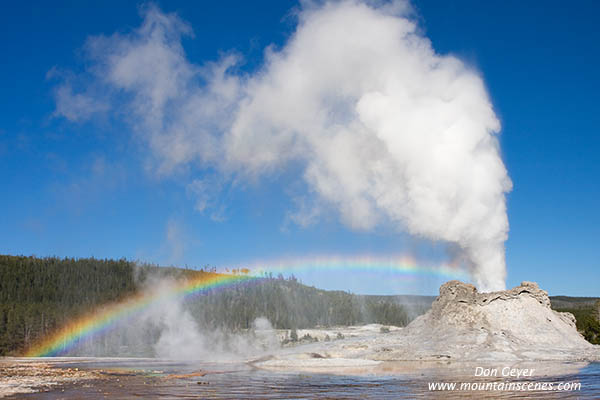
| Castle Geyser and rainbow. |
Morning is a great time to photograph wildlife throughout the park, reflections in the Firehole River and around Fountain Flat, and of course both Upper Falls and Lower Falls of the Yellowstone River.
![]() |
| Lower Falls and rainbow. |
To my disappointment, Tower Falls was not available during my visit. Nor was Gibbons Falls - both due to construction.
Rustic Falls, north of Mammoth Hot Springs, is quite nice. But it is north facing so the sun never hits all of it. It is best photographed on a cloudy day for even light.
Another waterfall worth checking out is Undine Falls, in the north section of the park. This might be a better autumn picture.
![]() |
| Crested Pool |
![]() |
| Old Faithful |
Obviously, you don't want to be shooting in the direction of the sun. Likewise, you don't want to be down wind of the erupting geyser! Understanding the direction the geyser will erupt will allow you to plan your composition, rather than be reacting to the elements.
Know the estimated schedule for each geyser's eruption ahead of time. This will put you in the best possible position to succeed. Schedules are available as handouts at the visitor center, posted at most of the geysers, and available on the park's web site.
One last word on the geysers is to study interesting forefronts that will add uniqueness to your composition and make your image stand out.
![]() |
| White Dome Geyser at sunset |
Many more images are available for viewing in my Yellowstone gallery.
Tuesday, April 13, 2010
Lower Geyser Basin - Yellowstone National Park
The Firehole River provides some excellent photographic opportunities from various locations between Madison and Upper Geyser Basin. This sunrise was caught not far from the Madison Campground near a bridge crossing. A short meadow stroll lead me to this composition.There were many other opportunities to capture the snaking Firehole River as well, including having the bonus of early morning fog hovering just above it.
Fountain Flat offers another opportunity for morning and evening photography. Here, still morning waters hold the reflection of clouds above.Further along the road a herd of bison can be carefully watched and photographed from the road. Definitely have awareness of your surroundings here. While I photographed a couple of bison from the safety of the opposite side of my truck, I caught the approach of two large bison coming up behind me - much too close for my comfort level - and quickly moved to my trucks opposite side!
Further south is Lower Geyser Basin, punctuated by more geysers and of course, the Fountain Paint Pots. The Paint Pots are an active pool of errupting mud, and are very pretty in color. Late afternoon light brings out the color and texture of the mud, making it the ideal time to photograph them. Unfortunately, I had cloudy skies during my visit, subduing the colors.
The Paint Pots are the most accessible and colorful example of such a thermal example withing the park. Mud pots differ from hot springs in that they have a very limited supply of ground water available. Also, they do not overflow, but rather errupt in the form of steam bubbles. Iron oxides give the mud at Fountain Paint Pots their pink and red shades of color.
The Paint Pots are fun to watch and even more fun to photograph. Trying to time the burst of the mud bubbles is challenging indeed and will test your reaction time! A good telephoto lens will be needed to test this skill.A wider lens will allow you to include the interesting mounds of mud along the edges. Lots of opportunities await the imaginitive photographer!
Futher along the boardwalk are a group of small geysers, highlighted by Clepsydra Geyser. Clepsydra is best photographed in late morning, not late afternoon when I photographed it! Here I tried to backlight it against a sky filled with looming storm clouds.This is the last of a series of posts from a trip to Yellowstone National Park last June. I hope you have enjoyed them and found some of my information useful for your own planning.
I just returned from an extended trip to Death Valley, and hope to have posts from this wonderful trip soon! Of course, I have many other projects taxing my time, including the launching of a brand new web site. I will do my best to get them up soon!
Wednesday, March 17, 2010
Firehole Lake Drive - Yellowstone National Park
About 2 miles north of Midway Geyser Basin is Firehole Lake Drive, one of the few places you can watch geysers from your car. It's not nearly as popular as Midway or Upper Geyser Basin, and is often missed by people in a hurry. Big mistake!Great Fountain Geyser reportedly erupts in a series of several bursts 100 - 200 feet high. I did get to witness an eruption, but it was from a distance with gray overcast skies (flat light). The terraced pools surrounding the geyser are magnificently beautiful and worth photographing in their own right, especially in the evening. They hold a reflection well!
Just northwest of Great Fountain Geyser is White Dome Geyser, an attractive geyser at any time of day with its white geyserite cone. I first visited the area in the morning to scout the area, and found the dramatic light under storm clouds to allow the imagination to run wild. Not a bad first impression!I returned that evening hoping to capture an eruption of White Dome in much more appealing light. We arrived a half hour early, after having spent time at Great Fountain Geyser, so as not to miss an early eruption.
We waited and waited, braving the increasing numbers of mosquitoes in hopes of catching a pleasant show. The scheduled time arrived and nothing. Then, some rumbling began and steam began to come out in spurts, teasing our expectations before settling back down to calmness again. This continued several times over the next hour. The few people waiting besides us grew tired of waiting and left. Still we held hope.
Light faded as the sun began to set to the west and the sky began to turn orange, then pink. All of a sudden the Geyser awoke - nearly 1-1/2 hours late. Oh, the show Mother Nature had in store for us! What a treat to capture evening light on the erupting steam!
Then as quickly as it had begun, it was over. Still I was full of jubilation for the spectacular treat we were offered. The smile on my face was permanent this evening, and was due to the pride I had in being rewarded for my patience and perseverance. As many times as we photographers are not rewarded, those times that we are can be very especially satisfying.
We finished our evening at the Lower Geyser Basin parking lot as the dramatic sunset continued to unfold before our eyes.
This is the fifth part in a series I am posting from our wonderful visit to Yellowstone National Park last June. I hope you enjoy it.
Next Up: Lower Geyser Basin and Fountain Paint Pots!
Monday, March 8, 2010
Midway Geyser Basin - Yellowstone National Park
"Hell's Half Acre", as it was colorfully referred to by Rudyard Kippling in 1889, is still alive and well, and a deservedly popular destination in Yellowstone National Park!Technically, Midway Geyser Basin is actually part of Lower Geyser Basin. But due to its isolation, it has established its own identity over the years, and deservedly so. It possesses two of the largest springs in the world: Grand Prismatic Spring and the now dormant Excelsior Geyser. Excelsior Geyser used to be the largest geyser in the world, erupting nearly 300 feet in the air before 1900. Today it is considered a hot spring discharging more than 4050 gallons of boiling water per minute.
The loop trail trail at Midway Geyser Basin is about a mile long and a very easy walk. It immediately crosses the Firehole River (which isn't a bad place to hang out) and climbs up the south bank of the river. Along the way you pass the colorful runoff stream from Excelsior Geyser Crater. The crater emits a large amount of steam. Though I tried to play with photographic possibilities, I didn't come away with anything successful.Further along the trail are the colorful Turquoise and Indigo Springs. Turquoise Spring has an underground connection with Excelsior Geyser. When Excelsior was active, Turquoise lowered nearly 10 feet. In June and July, Turquoise can be surrounded by a beautiful display of purple gentians.
Moving further along the trail one comes to the climax of the tour - Grand Prismatic Spring. Grand Prismatic is easily the highlight of Midway Geyser Basin, and probably my favorite spring to photograph due to its rich, vibrant colors. The brilliant oranges are extremely captivating as you search out compositions from along the trail.The patterns are also quite intriguing and fun to play with. They are numerous and very accessible from the boardwalk. Allow your imagination to run wild!
The colors of Prismatic are very dependent on the temperature of the runoff water. Yellow bacteria appear in the hotter water near the spring, while red, orange and brown are prevalent in the cooler water. Colors and patterns change from year year as a result. I've seen some beautiful shades of red in published images of Prismatic. My visit witnessed mostly oranges and browns.
Whatever the color, the attraction of Prismatic will likely win you over. Take your time and enjoy this beautiful spring. I encourage you to visit mid-morning for the best light.This is the fourth part in a series I am posting from our wonderful visit to Yellowstone National Park last June. I hope you are enjoying.
Next Up: Firehole Lake Drive!
Saturday, February 27, 2010
Upper Geyser Basin - Yellowstone National Park
Upper Geyser Basin in Yellowstone National Park is probably the most popular geyser area in the park, with a lodge, inn, visitor center and numerous stores and restaurants available to the visitor. It also contains most of the largest and most predictable geysers in the park, with iconic Old Faithful at the forefront.Old Faithful is a spectacular geyser - always impressive in its eruptions and emitting a chorus of "Oohs" and "Awes" from the crowd each time it erupts. It is the symbolic icon of Yellowstone, even having its own web cam for people all over the world to witness its display of power and beauty over the Internet.
On average, Old Faithful erupts every 76 minutes. Its eruptions last between 1-1/2 and 5 minutes, and reach a height of 150 feet. A path completely circles the geyser, allowing viewing from all sides.
The south side is the most popular viewpoint for the geyser, namely because it is the first area reached from the parking lot and is complete with benches and open areas for viewingFrom a photography standpoint, there are more interesting sides for composing the geyser. I found the north and east sides particularly attractive. But with geysers, more things come into play than compositions, starting with the direction of wind.
Another important thing to keep in mind when shooting geysers is the direction of blue sky. Eruptions tend to get lost in cloudy skies. Blue skies are preferred to add contrast and allow the fountain of water to really stand out. If you have mixed skies, this is important to consider.
Not far from Old Faithful is Castle Geyser - a beautiful geyser that often offers a rainbow in early morning and late afternoon. Eruptions from Castle Geyser last for about an hour, amazingly enough. So you'll have plenty of time to play with different compositions and angles. My favorite angle in the afternoon was from near the trail junction on the west side.
Castle Geyser in one of the oldest geysers in the park. It's cone measures 25 feet in height. It errupts every 10 to 12 hours at a height of 90 feet.
Just a short distance north from Castle Geyser is the first of several colorful pools - Crested Pool. Crested Pool is deep blue in color and surrounded by geyserite formations, mostly orange in color.
Pools are generally best photographed in the late morning, afternoon and evening when the air is warmer. Thermal features are difficult to photograph in the morning when steam developes due to the cooler air.
Be sure and bring your wide angle lens for the pools, especially if you want to include backgrounds in your compositions. I was fortunate enough to have a very interesting sky, allowing me to include the valley of the Firehole River in the background. This was my favorite composition of Crested Pool.
I've also forgotten to mention the importance of polarizers for bringing out the geyserite colors and deep blue and emerald water. Don't leave home without them!
Further north is Beauty Pool and Chromatic Spring - both intoxicating candy to the eye (and camera!). Beauty Pool offers a wide palete of colors ranging from green and blue to red, orange and yellow. It also requires a wide angle lense to capture the pool in its entirety. Again, a polarizing filter will help bring out these colors. I also found a warming filter to be a useful tool.
Of the two pools, I found Chromatic Spring to be my favorite with its color-rich spectrum and geyserite patterns. I played with a couple of different lenses here. There are many pattern elements that can be isolated here for some interesting compositions. Of course, a wide angle showing the interesting overall patterns under a blue sky are also quite captivating.
At the end of the trail is probably one of the most colorful pools of them all, Morning Glory. It is a prize indeed, and probably the most beautiful hot spring in the park. The boardwalk is very close to this pool, offering a very up-close and personal view. It also can creep into your pictures if not careful, and the photographer must keep this in mind while working the various angles for their composition.
While this might be the end of the trail, it is certainly not the end of the sights. The spur trail to Daisy Geyser and Punch Bowl Spring can be taken to Black Sand Basin, or one can retreat back to the car and drive to the Black Sand Basin parking lot. Either way, it is a very worthwile destination.
Black Sand Basin contains several attractive springs and geysers, most notably Emeral Pool. Emerald Pool is one of the most beautiful pools in the park with its deep green waters ad colorful runoff stream.This is the third part in a series I am posting from our wonderful visit to this park last June. I hope you are enjoying it and finding the information useful, perhaps for your own trip planning.
Next Up: Midway and Lower Geyser Basin!
Tuesday, February 16, 2010
Grand Canyon of the Yellowstone - Yellowstone National Park
Grand Canyon of the Yellowstone River is incredibly photogenic, especially if you like spectacular waterfalls. Witnessing the raw, thunderous power of both Upper and Lower Falls is very impressive.Both the north and south rim provide a variety of excellent viewpoints, with options of hiking even closer if desired. My favorite locations along the north rim were Lookout Point and Red Rock Point, the latter a 1/3 mile descent from Lookout Point to a very beautiful, up-close viewpoint - the location this first image was taken.
Grandview is also nice.
At the end of the north rim is Inspiration Point, a very interesting overlook of the canyon. It offers no view of waterfalls, but the expansiveness is impressive. I didn't walk away with anything exciting, but I think it would be a great place to capture dramatic clouds at sunrise.
The south rim offers excellent viewpoints at Upper Falls Viewpoint and the famous Artist Point. Upper Falls can be framed up close, or to include an arching bridge behind it. I found the bridge to be an attractive element.This is also the starting point for Uncle Tom's Trail, a very popular trail that descends precariously down to the edge of the river. However, this trail was closed during my visit.
I missed another viewpoint further south of the main one. Considering that I spent multiple mornings at this location, I really kicked myself for missing it!
Further down the road is the icon for the area - Artist Point. This viewpoint is a further away from Lower Falls than Lookout Point or Red Rock Point, but offers the classic composition of the river snaking toward you below the falls.
Artist Point can also be absolute mayhem, depending how many tour buses are in the parking lot. The viewpoint can get very congested and frustrating at times, with personal space often feeling compromised. Guided tourists only have a short amount of time to collect their snap shots (including groups posed in front of the falls) before hurrying back to their bus again. There is a conflict of different cultures and customs interacting here, with the English language often not a common ground.
The good news? As crazy as it can get sometimes, understand that all can change in only 10-15 minutes as the tour guides collect all their patrons and herd them back to the bus to move on to their next destination. I was amazed at how quickly things changed. Several times I witnessed the tour buses leave only to look around and see but a handful of people left and a suddenly quiet surrounding. So if you find yourself amongst the numbers, relax - take a deep breath, and be patient. You will surely be rewarded.
The observation deck at Artist Point is large, and offers subtly different perspectives depending on where you set up, so be sure and give it a quick scout. Also, there are other very rewarding compositions available before the observation deck, which some photographers actually prefer. Options abound for the attentive photographer!
There are a couple of things worth noting when photographing the falls. The first involves shutter speed. A slow shutter speed of 1/4 to 1/2 a second will blur the water and give it a smooth appearance, while a shutter speed 1/30 or faster will render the waterfall as our eyes see it. For larger waterfalls such as these, I think the faster shutter speed does a better job of capturing the power and intensity of waterfall. But play with it and find what you like.
The second item worth noting is the regular appearance of rainbows at the base of the falls in late spring and early summer. These typically appear mid-morning and add a beautiful element to your composition. I was successful in catching rainbows at the Upper Falls viewpoint and at Red Rock Point, but not at Artist Point.
Once you've exhausted your compositional ideas of Lower Falls from Artist Point, don't forget to turn around and follow the river down canyon. The colors in the canyon wall are very attractive and well worth your camera's time. This area was formed by a combination of lava flows and thermal action. The lava rock below the falls is much softer than above the falls, allowing the river to carve deeper into it. Geothermic activity also works to make this rock softer, and can be witnessed along the canyon walls on cool mornings in the form of steam.
The bright colors in the canyon walls are best witnessed under diffused light. The pinks really pop out when a thin cloud scoots in front of the sun. These colors are from the presence of iron and magnesium oxides, a product of the geothermal activity in the area.
Don't forget to visit Brink of Upper Falls to witness the intensity of the falls up close and personal. This is an impressive viewpoint of Lower Falls at the brink of the falls (as the name would suggest!). It's turnout is half way between North Rim Drive and South Rim Drive.
Another beautiful waterfall worth visiting in the area is Tower Falls about 17 miles north of the Canyon area. Unfortunately, the trail was closed due to washout during my visit. Hopefully you will have better luck!
This is the second part of a series I am posting from our visit to this wonderful park last June. I hope you are enjoying it and finding the information useful for your own planning!
Next Up: Upper Geyser Basin.
Tuesday, February 2, 2010
Mammoth Hot Springs - Yellowstone
Yellowstone National Park is truly an amazing place. Trying to pick your favorite area within the park can be quite difficult with everything that it offers. What are you into? Geysers? Waterfalls? Springs? Large lakes? Wildlife? Hey, its all there!We started our tour of the park at Mammoth Hot Springs in the northwest corner of the park, choosing to stay at nearby Indian Creek Campground. This has always been a favorite campground of mine. It's within a 10 minute drive from the Upper Terrace Drive, and offers more privacy than Mammoth Campground.
The Upper Terrace Loop Drive is an excellent place to start your tour of this area. Early morning offers the best viewing time, in my personal opinion. The lighting can be magnificent at this time, and the steam rising from Canary Spring can add a magical element to the sun's rays. You also stand a very good chance of seeing wildlife; bear, coyote, deer, elk and rabit all visit this area, and I was fortunate enough to observe all of them during my visit.A quick drive around the loop soon brings you to Orange Mound Spring. I found early morning to be an excellent time to photograph it from the north (which I found to be its most attractive side). Mid-morning to mid-afternoon better serves the more popular south and west sides. The spring, though viewable from the west, is best viewed and photographed from the east via the viewing platform.
Continueing along the loop, you pass Angel Terrace (also beautiful in early morning light) before returning to the begining at Canary Springs.
A boardwalk allows visitors access to multiple viewpoints along the Main Terrace and extends to Canary Springs. It is a highly recommended walk. Again, early morning is an excellent time to capture the mystique the steam offers as the sun peaks over the ridge to the east. It can, however, make close-up compositions challenging. If your desire is to isolate certain elements with a telephoto, you would do best to come back later in the day after temps have warmed up, resulting in less steam.
If you like to capture patterns, you will love this walk along the terrace! The are many opportunities to isolate patterns and formations in the limestone, colored by bacteria and algae - the stuff us photographers love!I was more moved by the ambience of the morning, watching the travertine crusts play peek-a-boo as the curtains of steam opened and closed. It struck me as fascinating in an eery way, adding - yes, I said it before - mystique.
The sub-surface rock at Mammoth Hot Springs is limestone, which is very soluble in hot water. When the calcium-rich waters rise to the surface, they deposite the terraces of travertine seen in these images. Again, bacteria and algae add the color to these features. Mother Nature can be beautiful, can't she?
There are a lot of contrasts to be witnessed too. The most obvious are the dead trees that the travertine crusts have enveloped. The terraces provide a rather hostile environment for vegetation!
Minerva Terrace, though not nearly as active as it once was, is still very attractive and worth the visit. It can be reached by descending the boardwalk from the Main Terrace, or by hiking up from the lower parking lot.
Palette Spring, shown at the very top, is a relatively new feature to the area, forming in only the last few years. It is beautiful! Early morning is the only time it receives direct sunlight due to its northeast facing. Soft light serves it best, in my opinion.
From a pull-out along the main road, one gets a great view of Canary Springs from below. Mid-morning is the best time for photographing this angle, and requires a telelphoto lens if you wish to isolate its colorful features.
Proceding further north along this road, one arrives at the lower parking lot and the town of Mammoth Hot Springs, where most all conveniences and supplies are offered. Elk are often seen lounging in the lawn and wandering thru town!
Speaking of wildlife, remember the variety I mentioned that inhabit this wonderful area? I witnessed this sow and cub my very first morning as I was driving down to Mammoth Hot Springs from our camp. I spotted the yearling out of the corner of my eye first, then watched it catch up with mom on the other side of the road and continue to graze with her. I photographed them for well over an hour, and could have continued longer!
That evening, my daughter and I watched a black bear traverse the slopes below Canary Spring and wander past the lower parking area and boardwalk before disappearing in the trees above, much to the relief of the rangers monitoring the situation!
We also had a resident bison at the entrance to our campground at Indian Creek. It became so comfortable that it wandered further in towards the campsites, requiring a ranger to be called to scare it off. There were many other wildlife sightings as well.
This is first part of a series I will be posting from our visit to this wonderful park last June. I hope you have enjoyed it and that it has given you some ideas for a trip to one of our national Parks, or even motivated you to plan a visit to Yellowstone itself.
Next up: Grand Canyon of the Yellowstone.