Showing posts with label fall colors. Show all posts

Saturday, October 24, 2020

Fall in the North Cascades!

Fall colors above Rainy Lake
The North Cascades are a fabulous place to spend time in the fall with vibrant colors all around.  The fall season begins as early as mid September in some areas, and lasts to mid-October in others.

A visit to areas around Mt. Baker in mid-September will find the berry leaves on fire.  Some of my favorite hikes for these are Boulder Ridge, Rainbow Ridge, Park Butte and Ptarmigan Ridge.  I'm sure there are more!

As the month of September moves on, many more places begin to turn vibrant red throughout the range.  By the end of the month, hikes near Rainy and Washington Pass along the North Cascades Highway (SR-20) become VERY popular destinations (too popular - go on a weekday and go early or late in the day).

The arrival of October sends most fall color enthusiasts into pandemonium!  Not only are the reds still typically vibrant, the needles of larch begin to turn gold.  Peak for the larch are typically close to mid-October.  By the time they are truly at peak, much of the reds will have likely disappeared in my experience.

Larch are found on eastern side of the Cascades only, mostly (if not entirely) north of I-90.  In the North Cascades, excellent places to view them are near Washington and Rainy Pass, as well as hikes reached from Winthrop, Twisp and Carlton.

Fall colors below peaks of the
North Cascades
Early October is also a fantastic time to make the drive to Artist Point, located at the end of the Mount Baker Highway (Highway 542).  There are no larch here, but picture perfect scenes exist right from the parking lot for those not wishing to hit the trail.

Of course every year can be slightly different on the timing, mostly based on temperatures and weather patterns.  The amount of precipitation during the summer months can also play a huge factor on the quality of colors.

In my experience, the biggest challenge to viewing late season colors are the big white snowflakes!  It can snow at any time in the upper elevations of the Cascades.  But the North Cascades seem to be especially prone to it, and likely in early to mid-October.  I have tried to revisit one of my favorite larch viewing backpacks on multiple occasions.  While my first visit at peak time went off perfectly, all my subsequent attempts have ended in being turned back by deep snow or storms.  So I've learned not to take anything for granted!

There are some things to be careful for during this time.  First off, it is hunting season.  So if you are visiting an area outside of North Cascades National Park, be sure to where bright clothes to be easily seen.

Mount Shuksan Reflection
The second is to be prepared for cold temperatures.  Sunny and nice days can be even colder than snowy days due to the lack of cloud cover insulating the air.  This is especially a concern in early mornings and late evenings.  Even if it is comfortable outside when you start out, be sure and throw some warmer layers in your pack, including jacket, hat and gloves.

As always, thanks for looking!  You can view more of my images from the North Cascades in my North Cascades Gallery.

Hope to see you on the trail!


Sunday, November 10, 2019

Columbia River Gorge, After the Fire

Multnomah Falls amidst fall colors in the Columbia River Gorge National Scenic Area, Oregon, USA.
Multnomah Falls
I recently visited the Columbia River Gorge National Scenic Area this fall for the first time since the horrendous Eagle Creek Fire.

The Eagle Creek Fire was started in September 2, 2017 by a 15-year old boy lighting fireworks during a well-broadcast burn ban.  The fire took off at an unbelievable clip.  The fire was reported at 4:00 pm on this day, and by the next morning it had already burned over 3,000 acres.  On September 5th, it actually jumped the Columbia River into Washington near Archer Mountain!  153 hikers were trapped in the backcountry, 6 miles up the trail.  When all was said and done, the fire had burned over 50,000 acres and took three months to finally contain.  It would have consumed Multnomah Lodge if it weren't for fire tenders.  The damage was devastating.

I really wasn't sure what to expect.  Though a totally different event, in my head I was expecting the same type of recovery as Mount St. Helens National Volcanic Monument after the eruptions.  To a large degree, I think this is true - at a much quicker pace due to the lower elevation.

Latourell Falls amidst fall colors in the Columbia River Gorge National Scenic Area, Oregon, USA.
Latourell Falls
In some places, if one is unsuspecting, it can be hard to see the signs of the fire.  In other places, not so much.  The underbrush has grown back quickly.  But the charred stumps still remain.  Trees that are continuing to thrive have the black scars on their lower half to remind them of the ill-fated event, yet proudly display their resiliency.

The signs are first noticed while driving along the scenic highway.  Fences that were not previously present have been erected above the road to catch any debris that may come skidding down the mountainside.

The trail from the lower Multnomah viewpoint up to the Benson Bridge has such fencing immediately above the trail.  Signs of the burn are everywhere, including very uncomfortably close to the lodge.  Along this trail are signs of darker times, as well as hope.  Many trees are charred on their lower half, yet stand stoically with their full health up high.  Other trees weren't as lucky.

The good news for people wishing to visit this area is that most of the waterfalls I visited are not affected for photography or simply enjoying from the traditional observation areas.  Of all the waterfalls I visited, only Wahkeena saddened me to sea a large charred stump at the based of the falls, much too large to disappear anytime soon through the course of nature.

Latourell Falls amidst fall colors in the Columbia River Gorge National Scenic Area, Oregon, USA.
Latourell Falls
The bottom line is that the Columbia River Gorge National Scenic Area is still a very beautiful place to visit.  Don't put it off!

To see more images from this area, be sure to visit my Columbia River Gorge Gallery at www.mountainscenes.com.

As always, thanks for looking!  Hope to see you on the trail!


Saturday, October 13, 2018

Mount Rainier NP in Fall


Mount Rainier above the bright red meadows of Paradise Park in fall, Mount Rainier National Park, Washington.
Mount Rainier National Park has always been a favorite fall color destination for me, offering a smorgasbord of reds, yellows and oranges any given year.  But this year there were some concerns about how these colors might unfold due to the hot, dry summer.  Typically such conditions stress the plants and do not result in the best autumn show.

Well, all worries went out the window around the last week of September when the colors  began to pop!

Mount Rainier above the bright red meadows of Paradise Park in fall, Mount Rainier National Park, Washington.
The most popular destination for fall colors in the park is Paradise Park above the Paradise Visitor Center.  Here the intense colors start at the parking lot and continue up several hundred feet through the meadows.  Hikers can walk the paved trails to Edith Creek, Nisqually Vista or Alta Vista - or all the above!

The wanderings can be endless and slow going during peak season as around every corner a different array of color combinations present themselves.

Image of a black bear in the fall foliage of Paradise Park, Mount Rainier National Park, Washington.
As you wander, keep your eyes open for wildlife. Chipmunks, marmots and pikas are numerous and will typically announce your presence. Deer are a common sight as well. Also, it is not uncommon to see black bear in the bushes feasting on the huckleberries as they try to fatten up for their winter slumber (always keep a safe distance away).

There are other nearby places for the casual visitor to enjoy fall colors as well, and with less crowds.  The Lakes Trail provides a beautiful hike through red foliage while visiting several small tarns.  Most of the colors are lower down near Reflection Lake, not on Mazama Ridge.

Mount Rainier above the bright red meadows of Paradise Park in fall, Mount Rainier National Park, Washington.
The trail to Bench Lake is another excellent area to enjoy the colors and views of the mountain.  Colors are reached just a short distance from the trailhead in wide open meadows.

Further away, Tipsoo Lake is also a splendid area to enjoy roadside fall colors.  Short hikes in the area offer further explorations.

Fall is probably my favorite season to be in the outdoors.  While the days can be warm, the nights can be crisp (as can early mornings and late evenings).  Be sure to have warm clothes with you!

Mount Rainier above the bright red meadows of Paradise Park in fall, Mount Rainier National Park, Washington.
All the images accompanying this story were taken this year - about 2 weeks prior to this writing, in fact.  To see more of these images, as well as images of the other areas I have mentioned, visit my Mount Rainier Gallery.

As always, thanks for looking!  Hope to see you on the trail!

Tuesday, November 5, 2013

Helpful Tips on Predicting Fall Colors

Wahkeena Creek below Wahkeena Falls.
 Overall, many photographers in the Pacific Northwest grew frustrated with the poor showing of fall colors in 2013.  There were colors to be had, mind you.  If you could get to the larch despite the early season snow fall, they were fantastic.  However, if looking for native deciduous trees in the lower hills or valleys, it was a trying time with many leaves simply turning brown and falling to the ground while other leaves waited to turn.

This was rather easy to predict, however, with the uncharacteristically dry summer we had - one of the driest on record.

Let's start with the basics.  The most important element needed for beautiful fall colors is leaf volume.  How is this achieved?  Typically, with a moderate summer.  Too wet of a summer can promote disease and insects.  In a drought summer, as we experienced with no rain in July and very little in August, volume will be limited.

Healthy leaves stay attached to the trees longer, and present a better quality viewing surface (nice, radiant colors).  Dry conditions, pests and disease disrupt leaf surfaces.

Bridal Veil Falls in Bridal Veil State Park.
Temperature and precipitation during the fall color season will also greatly affect the colors of leaves.  Cool temperatures during the night with no freezes or frost, coupled with bright sunny days will enhance the changing of the leaf colors.  Slightly dry conditions in the last half of the growing season and during the transition into fall promote the changing color effect.

Fall rain systems and long overcast conditions diminish color appearance.  So do gusty winds that blow the leaves from the trees.  Freezing temperatures and hard frosts will kill the color formation, simply turning the leaves brown.

Here's another tip:  Keep a record of prime fall color dates for a specific area(s).  Peak color dates tend to repeat themselves.

The images appearing in this blog were taken in the Columbia River Gorge National Scenic Area towards the end of October, 2013.  You will note mostly brown leaves on the ground with only a few gold one's serving as highlights.  Meanwhile, cottonwoods and other trees were still mostly green.

I hope this information helps you to better plan your fall color trips in the coming years.

Feel free to view other images from the Columbia River Gorge on my website.

See you on the trail!


Tuesday, October 22, 2013

Oxbow Bend in Fall - Grand Teton National Park

Mount Moran reflected in the Snake River at Oxbow Bend before sunrise, Grand Teton National Park, Wyoming, USA.
Grand Teton National Park can be an incredible place to visit in the fall.   The crowds have diminished, the colors are poppin', the elk rut is on, and bears and other wildlife are commonly seen as they prepare for the winter months.

Colors peak anywhere from the last week in September to the first week in October, typically.

There are many favorite places to photograph fall colors within the park.  Most popular are Schwabacher Landing, Oxbow Bent (pictured here), Snake River Overlook, Mormon Row and Blacktail Ponds Overlook.  You will rarely be alone at any of these locations.

The image above was taken at Oxbow Bend.  Early morning promotes calm water on the Snake River, helping to capture the reflection of Mount Moran in its waters.  Sunrise is best, and requires arriving well before sunrise to stake your spot along the shoulder of the road before the crowds arrive.

This image was recently leased to appear worldwide on an editorial news website.  It has been a very popular image for me.  I hope you enjoy.

As always, thanks for visiting!

Thursday, October 17, 2013

A Challenging Fall in the Pacific Northwest

Ingalls Peak and fall larches from snow-covered
Headlight Basin in the Alpine Lakes Wilderness.
The snow came early to the mountains of the Pacific Northwest this year, making it more challenging to visit some of the more popular larch shows in our area.  Couple this with colors running late and the government shutdown closing all the national parks in our state, and it has been a test for even the most patient and understanding photographers and hikers.

Despite a run of nice weather over the last week or so, temps remain cool up high (as one would expect) and the snow does not appear to be going anywhere.  The usual suspect for displays of larch have only been available to those prepared for snow travel.  These destinations include:   Ingalls Lake, Enchantment Lakes, Lake Stuart and Horseshoe Lake, Carne Mountain, Cutthroat Pass, Snowy Lakes, Blue Lake, etc.

What do we have to look forward to?  According my weather forecasting friends, October is not supposed to see any storms this year.  While we might have some minor systems move through, the extended forecast is one of relatively nice weather.

There are many areas of bright fall colors remaining to be enjoyed lower down in the coming weeks, including along the Columbia River Gorge, the lower western slopes of the Cascades, Sol Duc, Crescent Lake and Dosewalips areas of Olympic NP, and if one is willing to put some miles under their wheels, the northeastern part of our state is always a great choice.

Wherever you elect to go, remember that hunting season is well underway and the wearing of bright colored clothing is highly recommended if hiking in areas with hunters present.

Good luck in your search for colors and hope to see you on the trail!

Sunday, February 6, 2011

Mormon Row in Grand Teton National Park

Mormon Row is located just off Antelope Flats Road, and consists of four abandoned old barns. The barns serve as excellent foreground material when photographing the Cathedral Group of the Tetons, which consists of Grand Teton, Owens and Teewinott.

Spring is actually considered to be the best time to photograph these barns. The mountains still have interesting patches of snow on them, and the side lighting is stronger for better detail. Autumn sees much flatter light at sunrise.

Of course, my visit took place during autumn, so I had to deal with the hand I was dealt. I still enjoyed photographing from this location - enough so that I returned for sunrise after shooting in late-morning the previous day. The barn up top is probably the most photogenic of all the barns, and makes a great sunrise to mid-morning subject.

I found mid to late morning to also be quite interesting, and for more than just the barns. There are also numerous fences, gates and corrals available to frame the Cathedral Group with.


One can easily spend a full morning at Mormon Row, and still have reason to come back. Maybe you will photograph the barns on the north side of Antelope Flats Road one day, and the ones to the south on another day. Or maybe you will simply return with fresh ideas to try after reviewing your initial images. However way you choose to explore this historic area of Grand Teton National Park, enjoy!


I have recently completed my new Grand Teton National Park gallery, and have made it available for viewing. It includes my visits to Schwabacher Landing, Oxbow Bend, Triangle X Ranch, Mormon Row, and many places in between!

Wednesday, February 2, 2011

Oxbow Bend in Grand Teton National Park

Oxbow Bend is considered to be one of the prime photographic destinations within Grand Teton National Park. Located just 3 miles inside the entrance, it's still waters can offer a beautiful reflection of Mount Moran and surrounding peaks, and can be the scene of dramatic sunsets should clouds be present in the evening.

This body of water was formerly a portion of the Snake River that has been bypassed and has formed a lake. The results are very pleasing to the eye and attract photographers and tourists alike!

Photographers would do well to arrive early for sunrise. After my experience at Schwabacher Landing the day prior, I made certain to arrive at Oxbow Bend 1-1/2 hours before sunrise. I was alone much of this time! I would still recommend an hour early (as I would with any sunrise). The great thing about Oxbow Bend is that it offers a very large area for photography, unlike Schwabacker Landing. Photographers can set up in the parking lot or along the 1/4 mile of road to the west. Personally, I recommend staying close to the parking lot. I also found my best shots to be from mid to late morning. Early morning light in autumn is very flat here.

Plan on spending much of the morning here as there is a lot to do! After first light on Mount Moran, you'll have some dead time until the foreground begins to light up. As the morning moves on, I recommend moving further up the road.

There are many other posibilities as well. Above the road to the north is a trail that is frequented by horseback riders. Wandering along and near this trail offers all kinds of compositions not available from the road.

If your lucky, you might even come across a guided horse tour as I did. I created several compositions of the group of riders, but really like the isolation of this lone rider.

There are many other wanderings available in the area as well. Don't be in a rush to get back to camp!

When you are done, don't miss driving 1 mile further up the road to Jackson Lake Junction and visiting the viewpoint. While it doesn't offer much for photography, it's a pretty incredible panorama.

Next up: Mormon Row!

Monday, January 31, 2011

Buck-and-Rail Fences in Grand Teton National Park

There is a lot of history still present within Grand Teton National Park. Heck, this was cowboy country and the tradition is still carried on for commercial purposes within the park's boundaries.

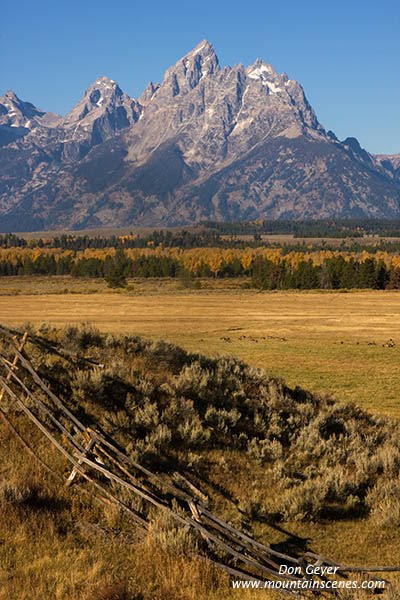
Part of the photogenic history within the park can be captured by incorporating the ever-present buck and rail fences into your composition. These fences can be found in several locations, but are most abundant along Highway 191. Here the fences line the west side of the highway and make excellent forefronts for the majestic Teton Range towering above.

One of the best locations is near the Triangle X Ranch turnoff, where the fence descends into a gully and back up the other side. This adds for some intriguing and attractive diagonal elements to your composition of the Cathedral Group.

There are many other scenic locations along this highway to include the fences in your composition as well, including a spot just before reaching the Cunningham Cabin turnoff. Here, several groves of aspen add attractive color in autumn. There are many cottonwoods that also grace the west side of the highway.

Granted, I haven't visited this area in the spring, but I found autumn to be my personal favorite season for photographing this area with the dried brown grasses and yellow color in the shrubs and trees. OK, so autumn is probably my favorite time to photograph the park in general!


Mid to late morning serves as the best light for photographing this area as the light can be quite flat in early morning. Also, keep a watch out for horseback riders, which can add a new element to your composition. With all the ranches nearby, trail riding in guided tours is quite popular, and offers an historic story to your images.

I hope you get a chance to enjoy this magnificent area sometime soon. It really is a special treat.

Thursday, January 27, 2011

Snake River Overlook - Grand Teton National Park

The Snake River Overlook in Grand Teton National Park is a grand panoramic view of the range, made famous by a fantastic image captured by Ansel Adams. At that time, the full "S" of the river could be viewed. Today that is not possible with the growth of the trees, but is still a very worthy place to set up your tripod.

This particular morning started off on the wrong foot. I lost my watch the previous morning while shooting at Oxbow Bend, and borrowed a watch to wake up with. Little did I know, its batteries were dying. Waking up to the sound of other people in your campground is never a good thing for a photographer!

Once I realized what had happened, I raced off to the nearest location from camp - Snake River Overlook. Granted it was a place that interested me and was in my plans to shoot, just not this day! I arrived in plenty of time for sunrise, and was surprised at how few people were present. In fact, there was only one other photographer there when I arrived - a stark contrast to Schwabacher Landing.

Pre-sunrise conditions were quite nice here, however early morning light is flat. This is a better late morning destination when shadows add some depth to your composition.

Snake River Overlook is also an excellent place to capture dramatic sunsets. Unfortunately, I was awarded clear blue skies each evening and was unable to capitalize on this knowledge. Next time!

Friday, October 15, 2010

Enjoy the Fall Colors!

Fall is one of my favorite seasons for photography, and for many reasons. The days are cooler, foliage and needles are turning brilliant colors, and the crowds are few. There are also a lot of different opportunities.

If you enjoy reds, then the berries are for you! Their foliage can start turning in mid-September in the North Cascades - especially around Mount Baker. Early October is more likely around Mount Rainier and other areas of the Central Cascades. The nice thing about these plants is that they can pretty much be found throughout the Cascades, both east and west side.

If you like the gold of larches, then the high country east of the crest is for you, begining in the Alpine Lakes Wilderness and stretching north. Though colors can emerge in late September, early to mid-October is the better bet. Some of the most renouned areas for lyall's larch in the Cascades are the Enchantment Lakes, Ingalls Lake, the Rainy Pass area of the North Cascades and further east into the Methow. There are many other possibilities as well (see my Ice Lakes trip in the Entiat Mountains below).

As colors fade in the high country, they are just begining to pop in the lower elevations. The Columbia River Gorge National Scenic Area is an excellent visit in late October, as are the many river drainages of the Olympics - Sol Duc being my favorite. Closer to Seattle are destinations such as the Japanese Garden on Lake Washington or the University of Washington campus.

I hope this gives you some ideas for the coming weeks for places to get out and enjoy nature's show. I hope to visit Tipsoo Lake and the Paradise area at Mount Rainier in the coming days. For those of you who have my book Mount Rainier, you know these are a couple of my favorite areas for fall colors at MRNP!

Where will you be going?

Saturday, October 17, 2009

Rampart Lakes in Fall

Rampart Lakes have held a special place in my memory ever since my first visit in 1996. For that visit, I arrived at the trail head in the dark of early morning and began my hike with headlamp in hopes of being at Rampart Lakes in time for somewhat early light. Colors were profuse, and I benefited from a recent dusting of snow on the higher peaks in tandem with a blue sky.

This trip would be a little different, though no less memorable.

I elected to do the trip as an overnight this time, wishing to enjoy both final and first light at the lakes. The forecast was for sunny skies the duration of my trip. As you can see, that was far from my experience.

I drove to the trailhead under mostly cloudy skies, and began my hike under similar fashion. As the morning wore on, the sun began showing signs of dominance with its bursts of light thru the weakening cloud layer, but it was not to be. By mid-afternoon, the clouds showed signs of strengthening.

As most photographers know, light cloudy skies are desirable for foliage as the diffused light brings out their natural colors. This served me well on close-ups of the lakes and the upper basin.


My goal, however, had been to photograph the recent snow on Rampart Ridge above the lakes, as I had in '96. I was never afforded the opportunity. When the lakes were lit, the ridge was dark and vice versa. Dem's da berries. You work with what you are dealt.

Discouraged by the clouds, I decided to climb up Rampart Ridge for a birds eye view of the area. The upper basin above the lakes was actually quite interesting, especially on my descent. The clouds above were working their magic on the sun's rays. Of course, I didn't realize it at the time. I planned to put my camera away for the evening.

I descended back to camp and waited. I watched the sky and the peaks around me. I've learned not to give up to soon, but these were thick clouds above. I had my doubts. The day had shown many signs that a predicted storm may have been advancing on the area quicker than forecast.

Still, I scouted compositions close to camp, which was placed in a most desirable location for reflections shots. Then I waited some more. Things did not look promising. I began cooking dinner and preparing for the cold night ahead.


Then it happened. The sun dipped below the cloud cover to the west and cast its magical light on the peaks around me. I raced to my camera, which was set up on Alta Mount. Hi Box was hid from me behind some trees near camp. After a couple of minutes of shooting Alta, curiosity got the best of me. I'm glad it did.


Nature often surprises you. I went into this trip with set hopes, and was totally thrown a curve. But in the end, I came away smiling and feeling blessed with what I had been served.

Monday, October 12, 2009

Fall Colors along Box Canyon Creek

A couple of weeks ago my friend Greg Vaughn and I had planned a trip up to Rampart Lakes to experience the fall colors. The trip fell through at the last moment due to me falling ill, but it remained on my mind.

Unfortunately, Greg's schedule wouldn't allow him to join me last weekend. And it was unfortunate, because he would have thoroughly enjoyed the colors at near peak conditions!

Driving to the TH along FS Road 4936, I couldn't help but notice a waterfall with yellow vine maple above it along Box Canyon Creek. The rock around it was also very interesting. I got out and scouted the area, choosing to descend down to the creek in search of interesting foreground. I didn't find much. I played with some things, but nothing I was very excited about. I slowly began working my way back to the truck, still keeping my eyes open for potential items of interest. Then I noticed a crimson colored bush slightly below me on the down-trending slope. I knelt down to view it from knee level and liked the possibilities. I composed several compositions similar to that above - all while laying on my side and my tripod low to the ground. I like this one the best.

Then it was off to the Rachel Lake TH - coming next!