Friday, March 25, 2011

Photographing Devil's Golf Course in Death Valley National Park

Evening clouds over Devil's Golf Course.

The Devil's Golf Course in Death Valley National Park is one of my favorite photography destinations in the park.  The area is just so interesting and different than anything I have previously experienced.  It's as if you've stepped onto another planet.

This magnificent place is accessed from the Badwater Road, 13 miles south from Furnace Creek.  The area closest to the parking lot is not very attractive, having been trampled by many feet.  But wander out a short ways and this will all change.  The rounded salt crystal mounds will turn to sharp, serrated formations that are much more interesting.

Be warned:  the salt crystals are very sharp and abrasive.  Sturdy boots, gloves and knee pads are highly recommended.

I was surprised at how little traffic Devil's Golf Course received during my visits.  It gets no where near the traffic that Badwater receives.  I found most visitors to be car tourists who quickly read the information signs, took in the immediate surrounding of the heavily abused area near the parking lot, then sped off to their next destination.  Very few remained longer than 10 minutes.

I spent a couple of evenings photographing this area, and found myself all alone at sunset both times.  During my second evening another photographer did show up and explore areas close to the parking lot.  After appearing frustrated, he packed up and drove off just before the prime light appeared!

Sunset over Devil's Golf Course.
Devil's Golf Course is a great location for wide angle and normal range lenses.  Getting low with your tripod can be a little challenging, both in the positioning of your tripod legs and being able to get low enough to compose your shot through the view finder.  Don't expect to be comfortable!  But do expect the rewards to be worth it.

A telephoto lens would be useful to play with the patterns, though I did not do this.  Do you get the feel that there is just so much potential here?

Graduated neutral density filters should be considered mandatory.  I would also consider a warming filter if you don't have access to this during post-processing.

I found evening to be the best time to photograph here, though mornings could still be rewarding as well.  Though the southern sky is typically considered the most rewarding for pinks and interesting colors, both images appearing here are actually of the northern sky.  Also, watch the Black Mountains at sunset and the Panimint Range at sunrise as these respective mountain ranges catch the suns special light.

I highly recommend making Devil's Golf Course part of your itinerary during your next Death Valley National Park visit.

Friday, March 18, 2011

2011 Washington State Visitors' Guide

Good friends Alan Bauer and Kim Brown
on Steamboat Rock.
I have an image appearing in the upcoming 2011 Washington State Visitors' Guide.  I was excited at the publisher's selection, because it includes two of my good personal friends, fellow photographer Alan Bauer and one of my favorite writers, Kim Brown.

This image is from the first trip that Alan and I did together, and was full of fun memories.  One of those memories was unexpectedly meeting Kim at the trailhead, and her joining us on our trek up Steamboat Rock.  This was also the trip I first met another friend, Karen Sykes - who reviewed my book Mount Rainier for the Seattle Post-Intelligencer.  Did I mention how fun this trip was?

Oh, but it get's even more interesting!


2011 Washington State Visitors'
Guide

Unbeknownst to me when agreeing to submit this image, it would accompany an article written by another friend and accomplished writer, Craig Romano - a mutual friend to all of us!

If you get a chance, check out the free online version.

Here's to more future trips and projects together!


Wednesday, March 16, 2011

Death Valley National Park Gallery

Early light on Manly Beacon from Zabriske Point
I've just gone live with my new Death Valley National Park gallery!  This gallery is comprised of images from a trip I did almost exactly one year ago, and includes images from Zabriske Point, Dante's View, Badwater Salt Pan, Devil's Golf Course, Mormon Point, Ashford Mill, Artist's Point, Golden Canyon, Furnace Creek, Mesquite Sand Dunes, Stovepipe Wells, Devil's Cornfield, Fall Canyon, The Racetrack, and more.

Puting this gallery together brought back a lot of memories for me, and I hope you find an image or two that touch you or maybe kindle your desire to visit this wonderful national park yourself.
Sliding rock at The Racetrack
I'll resume revisiting the photography aspect of each destination I visited within the park in my next posts.  If you missed them, you may view my previous posts of Artist's Palette and Zabriske Point.

I wish to take the time to say Thank You once again for your interest in my photography and endeavers.  As always, I am happy to answer your questions - either about photography or helping plan your own visit to any of the wonderful places I share on these pages.

Sunday, March 6, 2011

Spring Appearances Cancelled

Just a note:  I've elected to cancel my scheduled spring appearances in order to focus on some business projects.  I will surely have shows to announce later in the year - stay tuned.  Thank you for your understanding.

Thursday, March 3, 2011

Shi Shi Beach and Point of the Arches - Olympic National Park


Point of the Arches at the south end of Shi Shi Beach
 Winter isn't the time that most people think of visiting the coast.  After all, there's snow in the mountains and plenty of skiing, snowboarding and snowshoeing to do.  However, winter does offer some advantages (including having all those people in the mountains skiing, snowboarding and snowshoeing!).  The sun is further to the south in the winter months, offering softer light for a larger part of the day, and low and high tides tend to be more extreme.  With this knowledge in hand, a photographer can employ much creativity while exploring options not necessarily available to visitors later in the season.
Sunset at Point of the Arches
Of course, there are some downsides to visiting in winter as well, starting with temperatures.  My visit took place with snow in the forecast and temps in the 20's.  For Shi Shi in particular, this made the approach interesting with an icy boardwalk section and an icy crossing of Petroleum Creek.  Couple cold temps with the moisture present in the air, and it is very easy to get chilled to your core.  I strongly recommend a layer system and several extra pairs of socks.

As for camping, make sure you set your campsite in the trees.  While camping on the beach can be an attractive option in the summer, I can tell you firsthand that not much, if any, of the beach is safe in winter.  High tide can make much of the beach impassable in the winter months.

Sunset at Point of the Arches

From a photography standpoint, if you have visited Shi Shi in the spring, summer or fall, you may have some adjusting to do when planning your compositions. Did I mention that the sun sets much further to the south?  Much further than I anticipated I will admit.  Still, as long as you plan for this, there can be rewards.

The tidal pools around Point of the Arches are some of the best I have seen on the Washington coast.  Though they can be enjoyed in all seasons, the extreme low tides of winter make even more of them accessible and allow for further exploration.  But don't spend all of your time looking down.  Bald Eagles can be regularly seen flying overhead and even perching in the trees above the arches themselves.  Sea otters are also a common and fun sight.

Point of the Arches at dawn.
Campsights near the Point of the Arches can be ideal for quick and easy access.  Camps around Petroleum Creek afford a nice composition of having the winter sun set behind the sea stacks, with its light seen through two separate arches.

Raccoons must be reckoned with.  I've never experienced them in previous visits, but they were certainly present during my last visit.  Though I had a visitor at my camp near the point, they seemed concentrated around the campsites at the very north end (beginning) of Shi Shi Beach.  Remember that a hard food container is required (see the Olympic National Park web site).

For lenses, I found my 24-70mm most useful for landscape, and 70-200mm with 2x extender for tidal pools and wildlife.  Though I brought my 17-40mm, it never saw the light of the day on this visit.  Graduated neuatral density filters and polarizers are also important.

I hope you get a chance to visit our coast during its "off season".  I think you will enjoy it.

If you are interested in further viewing, I have other images from this area as well as Rialto Beach, Hole in the Wall, Ruby Beach, Strawberry Point, Toleak Point, Cape Alava and more in my Washington Coast gallery.

Monday, February 21, 2011

2011 Greater Seattle InfoGuide

I've worked with Vernon Publications for many years now, and have contributed images to several of their publications.  Recently, I was proud to learn that one of my images had made the cover of their 2011 Greater Seattle InfoGuide.  The image was taken only a couple months ago from Kerry Park on Queen Anne Hill - my first visit to this park.  I also have several images appearing within its pages, including an image of Qwest Field at sunrise taken from Dr. Jose Rizal Park on Capital Hill, an image of the city skyline from Hamilton Park in West Seattle, and an image of Point of the Arches at Shi Shi Beach in Olympic National Park.

The InfoGuide is a great publication to pick up if you are looking for things to get out and do, and is available at most hotels and tourist destinations around the greater Puget Sound area.

Wednesday, February 16, 2011

Photographing Yellowstone National Park

Canary Spring
Yellowstone National Park is an amazing place for photography.  There is so much variety available that something is bound to capture the interest of most shutterbugs.  The park has very distinct features, offering geysers, hot springs, waterfalls, terraces and mud pots.  Each of these features require a slightly different approach with the camera.

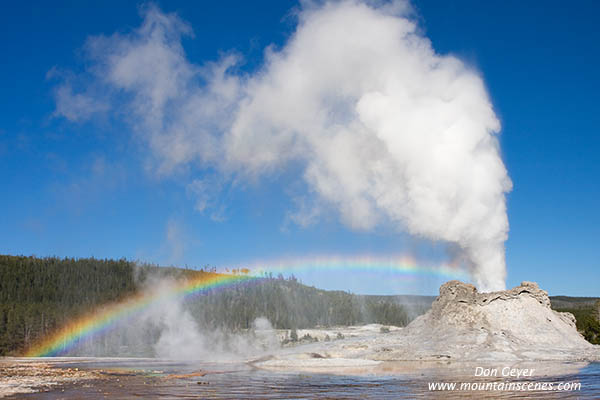
Castle Geyser and rainbow.
One thing to keep in mind as you visit the hot pools and geysers of the park is that hot water in cold air creates steam.  For this reason early morning isn't the best time to photograph the pools or geysers.  Steam can make the terraces at Mammoth Hot Springs quite interesting, however (still, you may wish to return later in the morning once the sun has warmed things up).

Morning is a great time to photograph wildlife throughout the park, reflections in the Firehole River and around Fountain Flat, and of course both Upper Falls and Lower Falls of the Yellowstone River.

Lower Falls and rainbow.
Rainbows can be a regular occurance at both Lower Falls and Upper Falls during morning hours.  Timing depends on weather (clear skies) and season.  Plan on between 8:30 am and 10:30 am.  Vantages that should be on your radar include Lookout Point, Red Rock Point, Upper Falls Viewpoint and Artist Point.  These are all spectacular!

To my disappointment, Tower Falls was not available during my visit.  Nor was Gibbons Falls - both due to construction.
Rustic Falls, north of Mammoth Hot Springs, is quite nice.  But it is north facing so the sun never hits all of it.  It is best photographed on a cloudy day for even light.

Another waterfall worth checking out is Undine Falls, in the north section of the park.  This might be a better autumn picture.

Crested Pool
Mid to late morning and late afternoon and evening is the best time to photograph the geyser basins.  Light is kind to you and the temperatures are warm enough that steam will not hinder your photos.  The colors surrounding the pools change with the light.  My personal favorites were Grand Prismatic Spring, Crested Pool, Chromatic Spring and Emerald Pool.

Sunny days are best for geysers.  Mostly blue skies allow for contrast and definition of the eruption.  Overcast days cause the plumes of water to blend against the cloudy sky and detail is lost.

Old Faithful
 Angle is another important element, and the one that I believe most people underestimate.  When shooting the geysers, take into consideration the direction of the wind and location of the sun. 
Obviously, you don't want to be shooting in the direction of the sun.  Likewise, you don't want to be down wind of the erupting geyser!  Understanding the direction the geyser will erupt will allow you to plan your composition, rather than be reacting to the elements. 

Know the estimated schedule for each geyser's eruption ahead of time.  This will put you in the best possible position to succeed.  Schedules are available as handouts at the visitor center, posted at most of the geysers, and available on the park's web site.

One last word on the geysers is to study interesting forefronts that will add uniqueness to your composition and make your image stand out.

White Dome Geyser at sunset
Sunset can also be a fun time to shoot the geysers.  Again, knowing their schedule is important.  Here, White Dome Geyser was scheduled to erupt shortly before sunset.  However, it was an hour late and its eruption timed perfectly with the evening light, allowing the setting sun to turn its plume pink!

I hope you have enjoyed these basic hints for photographing Yellowstone National Park.  Feel free to contact me with your questions if planning a visit of your own.  I am always happy to help!

Many more images are available for viewing in my Yellowstone gallery.

Friday, February 11, 2011

Visiting the Oak Creek Wildlife Area


A bull Rocky Mountain elk stands watch.
 The Oak Creek Wildlife Area encompasses 47,200 acres in Yakima County, just outside the town of Naches, Washington (15 miles west of Yakima).  It's a winter viewing and feeding area for both Rocky Mountain elk and California big horn sheep, and was established to resolve the conflict between these animals in search of winter food and private land owners, orchard growers, and livestock producers.

Rocky Mountain elk issues a challenge to nearby bull elk.
The California big horn sheep feeding area is located just off Highway 12 at the intersection of Highway 12 and Highway 410, just west of Naches.  Feeding time is around 10:00 am, so arriving around 9:00 am is recommended.  As with the elk, the animals become playful and frisky as meal time nears, and this is the best time to view and photograph their behavior.  The males in particular like to display dominance, and are often challenged when they do so!

Rocky Mountain elk playfully spar.
 Cold spells are the best time to view these animals. The colder, the better. Nice, sunny days with temperatures in the 10's or low 20's is ideal. If the weather has experienced a recent warm trend, it can mean food available up high and only limited numbers will descend to the feeding area - usually only females. Or, in the case of my most recent visit, they won't show up at all.

Rocky Mountain elk stand alert.
The main elk feeding station at park headquarters is located just a short distance up Highway 12 from the intersection with 410. There are other feeding areas, including at the intersection (easily missed if not observant), but the feeding station at park headquarters is the only one to offer a formal parking lot, visitors' center and guided tours. 

A Rocky Mountain elk anticipates feeding time.
The elk begin congregating early here, even though feeding time typically isn't until 1:30 pm.  The descend from the surrounding hills much like the sheep, and lounge in the large field - slowly migrating towards the feed barn as the morning wears on.

I recommend arriving here around 10:30, right after the feeding of the big horn sheep (once they are fed there isn't much reason to stick around).  The first tour truck departs at 11:00 am.  They then run every hour, or half hour depending on the demand.  Sign-ups are in the visitors' center and can fill up fast.  You can also call ahead and reserve your group's spot on the trucks.  Information is available at their web site, as well as information and directions to other viewing spots within the Oak Creek Wildlife Area.

Guided tour at Oak Creek Wildlife Area.
The tour trucks each hold a little over a dozen people. They drive out into the middle of the herd and park for 15-20 minutes, engine off. At this point people can move around freely on the truck for optimum viewing. I highly recommend the tour as a means to get closer to the animals and to be able to photograph them in a more natural setting (vs. having fences and barns in your background). The tour guides are always very informative too, and I have learned something new on each visit. Though the tours are free, please don't forget to offer your donation. It's your money that keeps this program going.

Oak Creek feed truck prepares for food drop.
The starting up of the loud diesel feed truck is like a dinner bell to the elk, and "cheaters" will approach the truck as the workers prepare their load.  The bundles of hay are dropped via a conveyor belt as the truck drives slowly across the field.  It is fun to watch the elk follow the truck across the field in anticipation of the next drop!

This is a winter feeding program only, and numbers of animals can vary from year to year depending on the harshness of winter.  Numbers were way down this year during my visit, sporting only 670 elk vs. the 1,000+ I have seen other years.  However, this decrease actually made it easier to photograph them, offering easier isolation of the animals.
A feed truck makes it's way through the herd at Oak Creek.

January and February are the best months to view these animals.  December is too early due to its closeness to hunting season; the animals are still quite nervous and stressed.  It is not uncommon to see maimed animals.  A three-legged cow has been present the past four years.  Unable to run or even walk fast, I'm amazed at her resiliency.

Oak Creek Wildlife Area is a place you want to visit and take the family.  I return each year with my kids in tow, and they absolutely love it.  Try it - you'll be hooked!


Sunday, February 6, 2011

Mormon Row in Grand Teton National Park

Mormon Row is located just off Antelope Flats Road, and consists of four abandoned old barns. The barns serve as excellent foreground material when photographing the Cathedral Group of the Tetons, which consists of Grand Teton, Owens and Teewinott.

Spring is actually considered to be the best time to photograph these barns. The mountains still have interesting patches of snow on them, and the side lighting is stronger for better detail. Autumn sees much flatter light at sunrise.

Of course, my visit took place during autumn, so I had to deal with the hand I was dealt. I still enjoyed photographing from this location - enough so that I returned for sunrise after shooting in late-morning the previous day. The barn up top is probably the most photogenic of all the barns, and makes a great sunrise to mid-morning subject.

I found mid to late morning to also be quite interesting, and for more than just the barns. There are also numerous fences, gates and corrals available to frame the Cathedral Group with.


One can easily spend a full morning at Mormon Row, and still have reason to come back. Maybe you will photograph the barns on the north side of Antelope Flats Road one day, and the ones to the south on another day. Or maybe you will simply return with fresh ideas to try after reviewing your initial images. However way you choose to explore this historic area of Grand Teton National Park, enjoy!


I have recently completed my new Grand Teton National Park gallery, and have made it available for viewing. It includes my visits to Schwabacher Landing, Oxbow Bend, Triangle X Ranch, Mormon Row, and many places in between!

Wednesday, February 2, 2011

Oxbow Bend in Grand Teton National Park

Oxbow Bend is considered to be one of the prime photographic destinations within Grand Teton National Park. Located just 3 miles inside the entrance, it's still waters can offer a beautiful reflection of Mount Moran and surrounding peaks, and can be the scene of dramatic sunsets should clouds be present in the evening.

This body of water was formerly a portion of the Snake River that has been bypassed and has formed a lake. The results are very pleasing to the eye and attract photographers and tourists alike!

Photographers would do well to arrive early for sunrise. After my experience at Schwabacher Landing the day prior, I made certain to arrive at Oxbow Bend 1-1/2 hours before sunrise. I was alone much of this time! I would still recommend an hour early (as I would with any sunrise). The great thing about Oxbow Bend is that it offers a very large area for photography, unlike Schwabacker Landing. Photographers can set up in the parking lot or along the 1/4 mile of road to the west. Personally, I recommend staying close to the parking lot. I also found my best shots to be from mid to late morning. Early morning light in autumn is very flat here.

Plan on spending much of the morning here as there is a lot to do! After first light on Mount Moran, you'll have some dead time until the foreground begins to light up. As the morning moves on, I recommend moving further up the road.

There are many other posibilities as well. Above the road to the north is a trail that is frequented by horseback riders. Wandering along and near this trail offers all kinds of compositions not available from the road.

If your lucky, you might even come across a guided horse tour as I did. I created several compositions of the group of riders, but really like the isolation of this lone rider.

There are many other wanderings available in the area as well. Don't be in a rush to get back to camp!

When you are done, don't miss driving 1 mile further up the road to Jackson Lake Junction and visiting the viewpoint. While it doesn't offer much for photography, it's a pretty incredible panorama.

Next up: Mormon Row!

Monday, January 31, 2011

Buck-and-Rail Fences in Grand Teton National Park

There is a lot of history still present within Grand Teton National Park. Heck, this was cowboy country and the tradition is still carried on for commercial purposes within the park's boundaries.

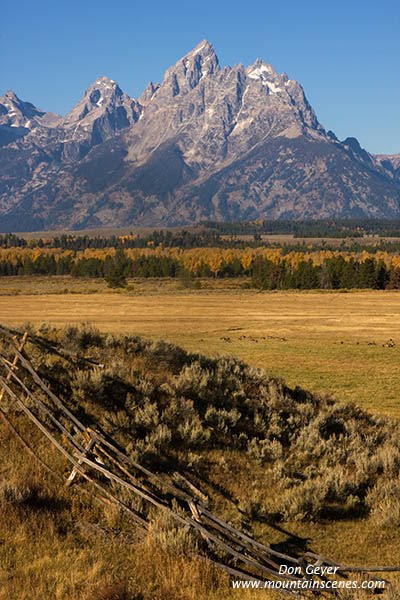
Part of the photogenic history within the park can be captured by incorporating the ever-present buck and rail fences into your composition. These fences can be found in several locations, but are most abundant along Highway 191. Here the fences line the west side of the highway and make excellent forefronts for the majestic Teton Range towering above.

One of the best locations is near the Triangle X Ranch turnoff, where the fence descends into a gully and back up the other side. This adds for some intriguing and attractive diagonal elements to your composition of the Cathedral Group.

There are many other scenic locations along this highway to include the fences in your composition as well, including a spot just before reaching the Cunningham Cabin turnoff. Here, several groves of aspen add attractive color in autumn. There are many cottonwoods that also grace the west side of the highway.

Granted, I haven't visited this area in the spring, but I found autumn to be my personal favorite season for photographing this area with the dried brown grasses and yellow color in the shrubs and trees. OK, so autumn is probably my favorite time to photograph the park in general!


Mid to late morning serves as the best light for photographing this area as the light can be quite flat in early morning. Also, keep a watch out for horseback riders, which can add a new element to your composition. With all the ranches nearby, trail riding in guided tours is quite popular, and offers an historic story to your images.

I hope you get a chance to enjoy this magnificent area sometime soon. It really is a special treat.

Thursday, January 27, 2011

Snake River Overlook - Grand Teton National Park

The Snake River Overlook in Grand Teton National Park is a grand panoramic view of the range, made famous by a fantastic image captured by Ansel Adams. At that time, the full "S" of the river could be viewed. Today that is not possible with the growth of the trees, but is still a very worthy place to set up your tripod.

This particular morning started off on the wrong foot. I lost my watch the previous morning while shooting at Oxbow Bend, and borrowed a watch to wake up with. Little did I know, its batteries were dying. Waking up to the sound of other people in your campground is never a good thing for a photographer!

Once I realized what had happened, I raced off to the nearest location from camp - Snake River Overlook. Granted it was a place that interested me and was in my plans to shoot, just not this day! I arrived in plenty of time for sunrise, and was surprised at how few people were present. In fact, there was only one other photographer there when I arrived - a stark contrast to Schwabacher Landing.

Pre-sunrise conditions were quite nice here, however early morning light is flat. This is a better late morning destination when shadows add some depth to your composition.

Snake River Overlook is also an excellent place to capture dramatic sunsets. Unfortunately, I was awarded clear blue skies each evening and was unable to capitalize on this knowledge. Next time!